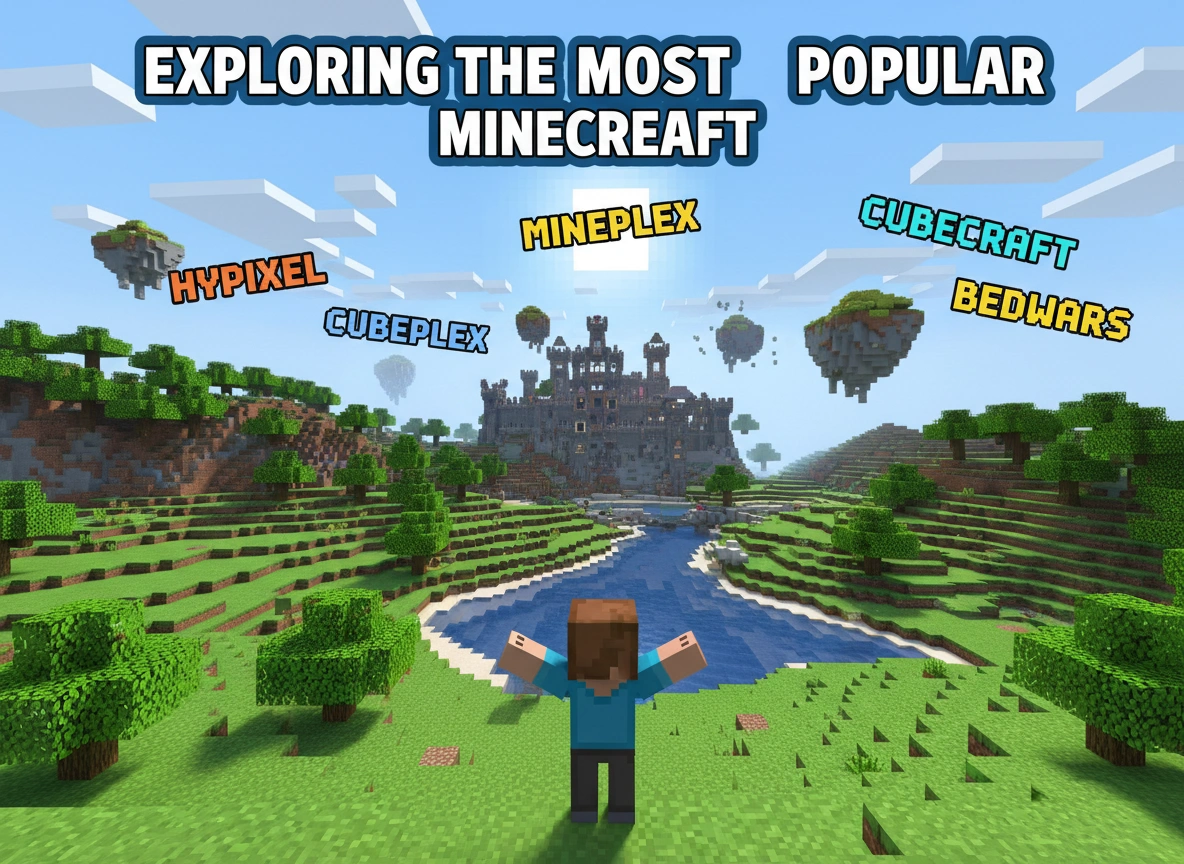
Minecraft is far more than a simple game about placing blocks and surviving the night. It is a massive, player-driven universe that relies heavily on its vibrant multiplayer ecosystem. For millions of players, the true magic happens when they log online to connect, compete, and create with others.
If you want to understand how a simple sandbox game became a cultural phenomenon, you must look at its multiplayer networks. This article will guide you through the significance of Minecraft servers and trace their fascinating evolution. We will explore legendary networks like Hypixel, Mineplex, and The Hive, examining their unique features and massive community impact. Finally, we will uncover how custom servers and mods have reshaped not just Minecraft, but the broader gaming landscape.
The Heart of the Community: Why Servers Matter
When Minecraft first launched, it was primarily a solitary experience. However, the introduction of multiplayer servers completely transformed the landscape. Servers provide centralized hubs where players can gather, collaborate on massive builds, or battle for supremacy. They turn an isolating survival simulator into a bustling digital society.
These networks act as independent virtual worlds with their own economies, rules, and cultures. For many players, a server becomes a digital home. They forge lasting friendships, develop complex political systems within factions, and participate in events that draw thousands of concurrent users.
The significance of these platforms cannot be overstated. They keep the game fresh and engaging long after the core survival mechanics have been mastered. Without servers, Minecraft would likely have faded into obscurity instead of remaining one of the most played games in history.
Building the Foundation: A Brief History of Multiplayer
The evolution of Minecraft servers is a testament to community ingenuity. In the early days, multiplayer was a bare-bones affair. Players had to host servers on their own computers, carefully sharing IP addresses with friends. These early servers were unstable, prone to crashing, and could only support a handful of players at a time.
As the player base grew, so did the demand for better infrastructure. Dedicated hosting companies emerged, allowing tech-savvy players to rent powerful machines capable of supporting dozens, and eventually hundreds, of users. The real breakthrough came with the development of server modifications, or “plugins.” Software like Bukkit and Spigot allowed server owners to alter gameplay mechanics without requiring players to download any mods themselves.
This innovation sparked a golden age of creativity. Server owners began programming automated minigames, complex economic systems, and custom chat channels. What started as small groups of friends surviving together quickly morphed into massive, commercialized networks hosting thousands of simultaneous players. The server ecosystem evolved from a simple multiplayer feature into a multi-million-dollar industry.
Giants of the Blocky Universe
Several networks have risen to legendary status within the community. These servers pushed the boundaries of what was possible within the game’s engine, attracting millions of unique logins and defining the multiplayer experience for a generation of gamers.
Hypixel: The Undisputed King
No conversation about Minecraft servers is complete without mentioning Hypixel. Founded in 2013 by Simon Collins-Laflamme and Philippe Touchette, Hypixel started as a platform to showcase custom adventure maps. It quickly pivoted to hosting original minigames and never looked back. Today, it stands as the most popular server in the game’s history, holding four Guinness World Records.
Hypixel’s success stems from its relentless pursuit of quality and innovation. The network offers a massive variety of game modes, from the fast-paced PvP of BedWars to the long-term progression of SkyBlock. Hypixel SkyBlock, in particular, revolutionized the server landscape by introducing deep RPG mechanics, an intricate player-driven economy, and continuous content updates.
The community impact of Hypixel is monumental. It serves as the primary multiplayer hub for millions of players globally. The development team’s commitment to polishing gameplay, balancing economies, and combating cheaters has set the gold standard for server management.
Mineplex: The Classic Innovator
Before Hypixel claimed the throne, Mineplex was the dominant force in Minecraft multiplayer. Launched in 2013, it quickly became a household name for players seeking quick, engaging minigames. At its peak, Mineplex frequently shattered concurrent player records, proving that Minecraft networks could scale to unprecedented sizes.
Mineplex introduced several iconic game modes that inspired countless imitations. Games like Super Smash Mobs, which adapted the mechanics of fighting games into the Minecraft universe, showcased the server’s creative potential. They also popularized the “hub” system, where players spawn in an interactive lobby filled with parkour challenges and cosmetics while waiting to join a game.
While Mineplex eventually lost its top spot to newer competitors, its legacy remains intact. It proved that large-scale, professional server networks were viable and highly profitable. Many of the user interface designs and lobby mechanics pioneered by Mineplex are still used by modern servers today.
The Hive: The Minigame Pioneer
The Hive (also known as HiveMC) launched in 2013 and quickly carved out a dedicated following. Known for its distinct visual style and highly polished minigames, The Hive became a staple of the European Minecraft community. The server placed a strong emphasis on clean code, resulting in smooth, lag-free gameplay that kept players coming back.
The Hive is perhaps best known for its original take on popular concepts. Their version of Hide and Seek (BlockParty) and survival games remain some of the most beloved iterations in the game’s history. Furthermore, The Hive successfully transitioned to the Bedrock Edition of Minecraft, becoming an official partner and tapping into the massive console and mobile player base.
This pivot to Bedrock ensures The Hive’s ongoing relevance. By adapting to new platforms and maintaining their commitment to high-quality minigames, The Hive demonstrates how older server networks can evolve and thrive in a changing landscape.
Breaking Boundaries with Custom and Modded Servers
While minigame networks attract the largest crowds, custom and modded servers offer entirely different experiences. These servers utilize massive modpacks to fundamentally alter the game. They add new dimensions, complex machinery, magical systems, and thousands of new blocks.
Modded servers cater to niche communities that crave depth and complexity. A server running a technical modpack might require players to build functioning nuclear reactors, automated assembly lines, and digital storage networks. These environments demand teamwork, intense problem-solving, and long-term planning.
Custom servers also push the boundaries of storytelling. Roleplay servers, for instance, enforce strict rules where players must stay in character, participating in elaborate narratives set in medieval fantasy worlds or dystopian futures. These specialized servers prove that Minecraft is the ultimate blank canvas, capable of hosting nearly any genre of gameplay imaginable.
Shaping the Broader Gaming Culture
The influence of Minecraft servers extends far beyond the game itself. Many popular gaming trends can trace their roots back to the mechanics pioneered by these blocky networks. For example, the massive success of the Battle Royale genre owes a significant debt to Minecraft “Survival Games” servers.
These early servers took the concept of the Hunger Games and turned it into a playable, highly competitive format. Players spawned in a circle, looted chests, and fought to be the last one standing as the map slowly shrank. Long before games like PUBG or Fortnite dominated the market, Minecraft servers were testing and refining the Battle Royale formula.
Furthermore, these servers served as a training ground for game developers. Many programmers, level designers, and community managers who cut their teeth running Minecraft networks have gone on to work for major gaming studios. The server ecosystem essentially created a grassroots pipeline for tech talent.
Conclusion
Minecraft servers are the lifeblood of the game’s enduring success. They transformed a simple building game into a vibrant, ever-changing digital universe. From the early days of sharing IP addresses to the massive, multi-million-dollar networks like Hypixel, the evolution of multiplayer has been nothing short of spectacular.
These networks continue to innovate, offering everything from fast-paced competitive minigames to deep, modded roleplay experiences. They have shaped broader gaming trends and fostered communities that span the globe. As long as players crave connection and creativity, Minecraft servers will continue to thrive and push the boundaries of virtual interaction.
To experience this incredible ecosystem for yourself, launch your game and explore the multiplayer tab. Try a minigame on Hypixel, join a Bedrock server on The Hive, or seek out a small modded community that fits your interests. The perfect digital world is out there waiting for you.
